Rules and random table from 0 to 9
The rule set defines stats, weapons and items. Checks and combats are decided by a random number from 0 to 9.
The rule set
The rule set applies to the whole series. You find it on the Rule set tab. Everything can be renamed, and the new name appears in the selection lists, in the test play and in the book. Changes are saved automatically.
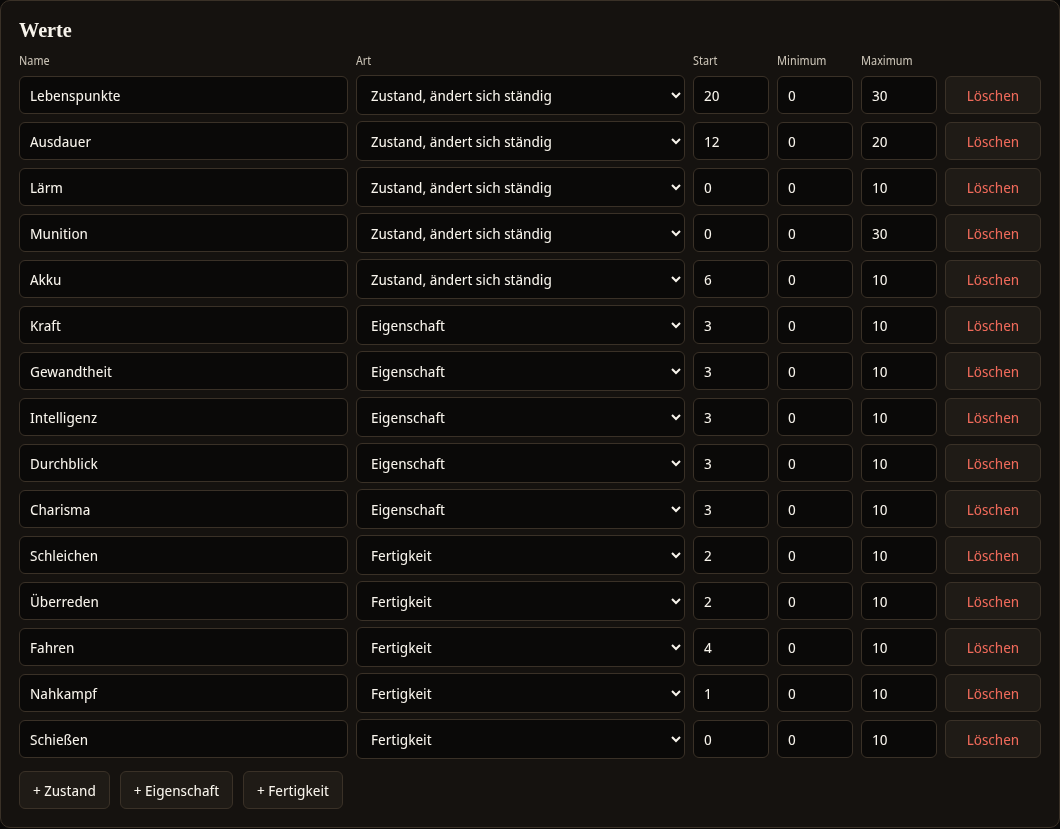
Stats
A stat is a number that your reader carries through the game. There are three types:
- Status, changes constantly: for example health points, stamina or ammunition.
- Attribute: a fixed strength, for example Strength or Charisma.
- Skill: something that has been learned, for example Sneaking or Driving.
Each stat has a starting value as well as a minimum and a maximum. The columns are called Start, Minimum and Maximum. On a phone each stat appears as a card of its own, with the label above each field. With + Status, + Attribute and + Skill you create new stats.
If a stat is still used somewhere, for example in a check, and you select Delete, the Spielbuchschmiede first shows all places. Only with Remove everywhere and delete does the stat disappear from all sections. Affected checks lose their check in the process. With Cancel everything stays as it is.
Basic rules
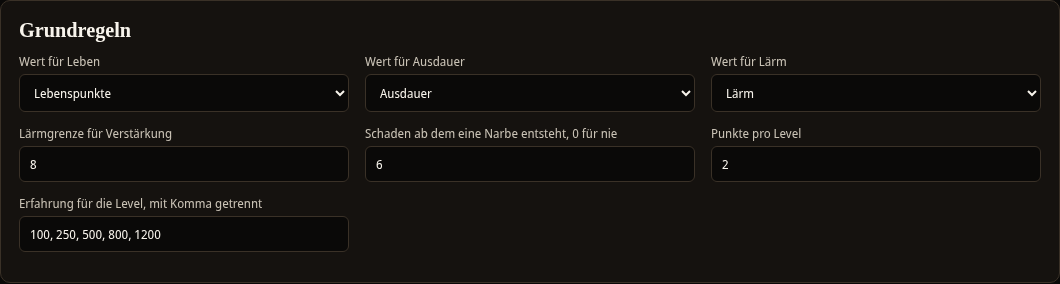
Under Basic rules you tell the Spielbuchschmiede which stat stands for life, stamina and noise. There are also the Noise limit for reinforcements, the damage at which a scar is created, the Points per level and the Experience for the levels.
Weapons, items, statuses and scars
- Weapons have a name, a stat for hitting, optionally a stat for damage and ammunition, bonuses, the Noise per round and a text for a 0.
- Items are things that the reader can receive or lose.
- Story statuses are switches that are on or off, for example "Door broken open".
- Scars change a stat permanently. They are created in combat when the damage is high enough.
Items and statuses can only be selected if you have created them here. Otherwise the sections show Create in the rule set first.
Rule set templates
When you create a series you choose a template. It determines which stats, weapons and rules the rule set has at the start. You can change everything afterwards.
- Classic: Agility, Strength, Luck. Three stats. A combat runs in rounds with two dice, and the higher sum hits. A luck check succeeds with a roll up to the value of luck, after which luck drops by 1. Example: A check on luck with a roll of 8 and luck 9 succeeds, and luck drops to 8.
- Disciplines and combat strength with random table. Combat strength, stamina and eight disciplines, of which the reader sets some to 1. Choices can require a discipline. Example: A path is only open if the discipline Camouflage is set to 1.
- Narrative only, no stats. The rule set is empty. There are no checks and no combats. The reader decides only through their choice.
- Puzzles and inventory. Items and statuses as well as the stats Clues and Insight. There are no health points and no combats. Example: A door is only open with the key.
- Group adventure. A group of three characters with their own stats and weapons. Checks are made by the strongest living member.
When you select Create series, you choose the template under Choose rule set. On the Rule set tab, the Rule set template card replaces the whole rule set with a template. This only works as long as the series has no sections yet. Existing volumes stay unchanged, even if you later create new series with other templates.
Two dice, checks against a stat and alternating combat
Three settings under Basic rules belong to the classic template and are available for every rule set:
- Random number for checks with a roll and in alternating combat: a digit from 0 to 9 or the sum of two dice from 2 to 12. In the test play the Spielbuchschmiede draws the number itself. In the book it then says "Roll two dice", so your reader needs real dice. The random table on the phone continues to show digits from 0 to 9.
- Type of check in a choice with a dice check: Roll is at most as high as the stat succeeds if the roll is not above the stat, for example with luck. With The stat then drops by the reader pays after every check, however it turns out.
- Type of combat: In alternating combat the reader and the opponent roll. The reader's stat for hitting is added to the reader's roll, and the opponent's strength, which is then their combat value, is added to the opponent's roll. The higher sum hits and costs the other the Damage per hit, 2 without a weapon bonus. With equal sums nothing happens. With Cover the damage is halved. Whoever flees and fails is hit once.
The combat with attack, cover and escape, as described further below, always uses the digit from 0 to 9.
Narrating without stats
A rule set without a stat for life knows no dying. A check cannot be created then, because no stat is available to choose. A section of the type Combat is reported as an error by the validation as long as the rule set has no stat for life and no weapon.
The random number from 0 to 9
Your book works without dice. Every random number is a digit from 0 to 9. Where it is needed depends on how your reader plays:
- In the book there is a random table at the end. Your reader closes their eyes, taps the table with a pencil and reads the digit under the tip.
- On the phone there is the Random tab. Touching the table shows a digit. With Once more you get the next one.
- In the test play the Spielbuchschmiede draws the number itself.
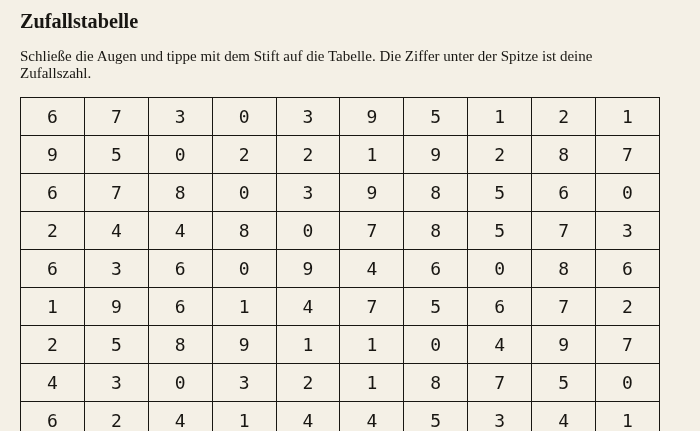
The table in the book has ten rows with ten digits each. More about the phone can be found under Phone and QR code.
Checks
In a check the random number is added to the stat you chose for the check. If the sum reaches or exceeds the Target, the check succeeds. Otherwise it fails. Each of the two outcomes has a section of its own. How you create a check is described under Sections and choices. If your reader plays a group, the strongest living member makes the check. This is described under Group and guests.
In the printed book the check appears as a line below the section, for example: "Check on Sneaking, target 8. Success: turn to 5. Failure: turn to 6."
Combats
A combat has an opponent with Strength, Health points and Damage. In the test play your reader fights in rounds and selects Attack, Cover or Escape. The Escape button only appears if you have set a section for escape in the combat.
- With Attack, the random number, the stat for hitting and the bonus of the weapon count together. If they reach the strength of the opponent, the attack hits.
- A 9 always hits and does double damage. A 0 always fails, and the opponent then strikes back harder.
- After every attack the opponent strikes back as long as it still has health points. From a 7 the reader dodges and takes no damage.
- With Cover the damage the reader takes is halved.
- With Escape the random number and the stat Agility count together. If they reach the Escape target, the reader escapes.
You check whether a combat is too hard or too easy with Check combats with in the validation report. This is described under Validation.
More mechanics
Combining items, puzzles, quests, relationships, difficulty, time and choices across several volumes are described on a page of their own: Dialogue, puzzles, quests and more.